
Client: Invest Fortuna
Website: investfortuna.com
Industry: Financial services and investment
Focus: Website design and development, user experience, content structure, responsive design, and search engine optimization.
1. Project Overview
In the financial services industry, a website is more than a digital introduction to a company. It is an important touchpoint where potential clients learn about the business, explore its expertise, and decide whether they feel confident taking the next step.
For financial brands, this experience requires a careful balance between professional presentation, accessible information, and credibility. Visitors should be able to understand the company’s services without navigating confusing layouts or interpreting unnecessarily complicated language.
Invest Fortuna’s website project centered on the importance of creating a professional digital experience that helps visitors explore the brand and its financial offerings.
At Adpixxels, we approach website development by looking beyond visual appearance. Our focus is on how design, content organization, navigation, and technical implementation work together to support the user’s journey.
For a financial services website, that means making important information easier to discover, maintaining consistency across pages, and ensuring that the website communicates its purpose clearly.
The broader objective is to create a digital presence that reflects the professionalism expected from a financial brand while establishing a foundation for ongoing content development and search visibility.
2. Understanding the Challenges of Financial Website Design
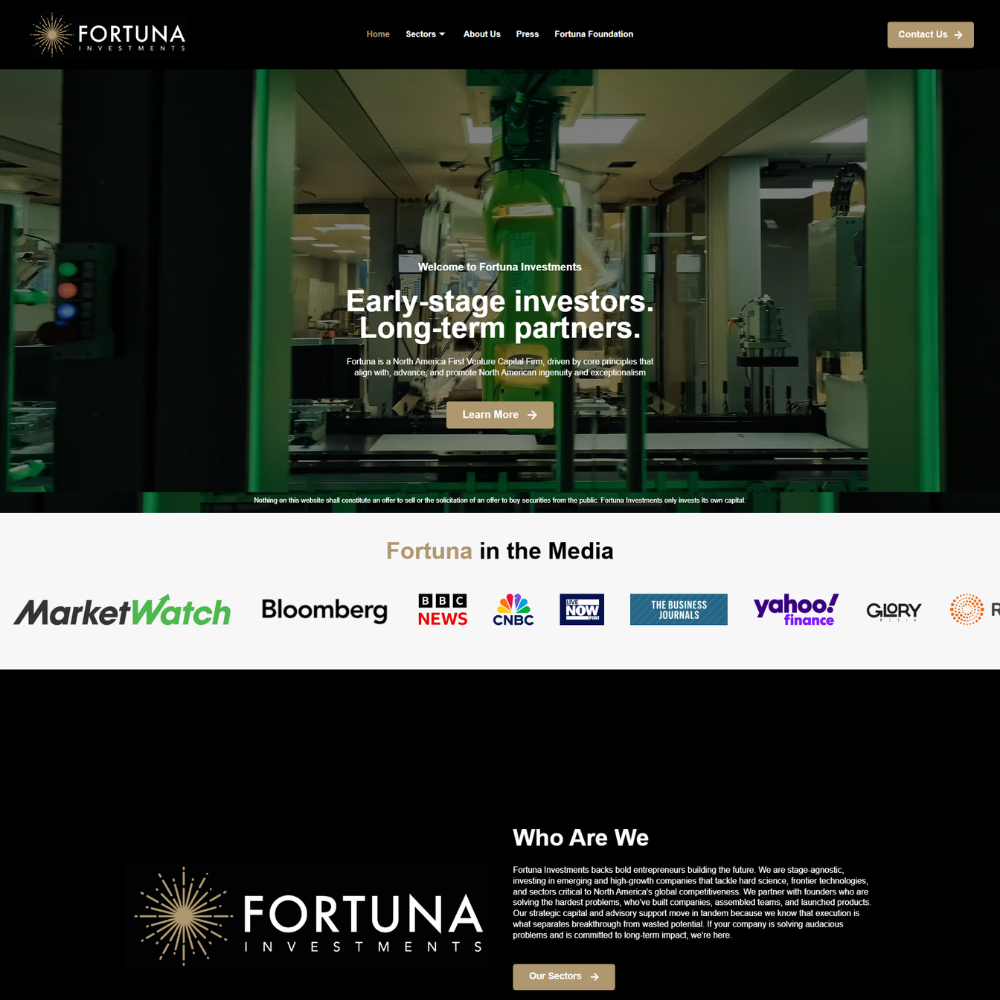
Financial services websites face different challenges from those of many other business websites.
Visitors may arrive with varying levels of financial knowledge, different objectives, and different expectations. Some want to understand the company’s background, while others are researching its services or looking for a way to get in touch.
A website must accommodate these needs without overwhelming visitors with information.
Communicating complex information clearly
Financial terminology can be difficult for visitors who are unfamiliar with the industry. If service descriptions are too technical or important information is buried in lengthy paragraphs, users may struggle to understand the company’s offering.
Clear content structure and accessible language help make the experience more approachable.
Establishing professional credibility
Financial decisions often involve significant consideration. Visitors naturally look for signs that a business presents itself professionally and communicates its services responsibly.
Consistent branding, well-organized content, accurate company information, and a polished interface all contribute to the website’s overall impression.
Creating intuitive navigation
When visitors cannot quickly identify where to find information, the website introduces unnecessary friction.
A logical navigation system helps users move between the homepage, service information, company background, relevant resources, and contact options without having to guess where content is located.
Supporting visitors across devices
A potential client might discover a financial services business through a Google search on a smartphone and return later on a desktop computer.
The website should provide a consistent, readable experience across screen sizes, ensuring that important information and enquiry options remain accessible.
These considerations informed the user-focused principles behind the project.
3. Building a Better User Experience Through Structure
One of the most important aspects of website redesign is information architecture: how content is organized and connected.
A visually attractive website can still be difficult to use if its information is poorly structured. Conversely, a clear layout can help visitors understand the business even when they are encountering the brand for the first time.
For Invest Fortuna, the key design principle was to treat the website as a guided information experience rather than simply a collection of pages.
Creating a logical content hierarchy
A clear hierarchy helps users understand which information matters most.
Headlines introduce the main topic of a section, supporting copy explains the details, and calls to action provide an obvious next step.
Consistent heading levels, readable paragraphs, and appropriately spaced content also help visitors scan pages more efficiently.
Making information easier to discover
Navigation should reflect the questions visitors are likely to ask about the business.
Potential clients should be able to locate relevant service information, learn about the company, explore supporting content, and find contact details without navigating an unnecessarily complicated menu.
A well-planned structure also makes the website easier to maintain as new pages and resources are introduced.
Creating a consistent experience
Repeated elements such as buttons, navigation menus, content sections, and footers should behave consistently throughout the website.
This predictability reduces the effort required to learn how the interface works. It also helps establish a cohesive visual identity across the entire digital experience.
The result of this approach is a website structure designed to make information more accessible and the overall journey easier to follow.
4. Designing for Credibility and Professional Presentation
In financial services, visual design contributes to how visitors perceive a business.
An inconsistent color palette, crowded sections, difficult-to-read typography, or poorly aligned elements can make a website feel less professional than the business it represents.
A considered design system helps address these issues by establishing consistent visual rules.
A focused visual identity
A restrained color palette, clear typography, and consistent spacing can create a professional interface without relying on unnecessary decorative effects.
The design should reinforce the brand’s identity while keeping the information easy to read.
Clear calls to action
Visitors should understand what they can do next.
Whether they want to explore a service, read more about the business, or submit an enquiry, the relevant action should be clearly presented within the page structure.
Calls to action should be descriptive and appropriately placed rather than competing for attention with multiple unnecessary buttons.
Content that supports trust
Professional presentation must be supported by useful and accurate information.
Clear company details, relevant credentials, appropriate disclosures, and accessible contact information help visitors understand the organization.
For financial brands, any statements about investment performance, security, regulatory status, or expected returns must be accurate and properly substantiated. Visual design alone cannot establish those claims.
5. Responsive Development and Technical Foundations
A modern website needs to work reliably across different devices and browsing conditions.
Responsive development adapts the interface to the available screen size while preserving the content hierarchy and functionality.
For a financial services website, this includes ensuring that text remains readable, navigation works intuitively, and important information is not hidden behind awkward layouts.
Technical quality also affects the experience after the page appears.
A useful development checklist includes:
- Optimizing images and other media assets.
- Reducing unnecessary scripts and third-party resources.
- Maintaining consistent spacing and typography.
- Checking forms, links, and navigation for functionality.
- Ensuring the website uses HTTPS.
- Testing layouts across desktop, tablet, and mobile devices.
- Monitoring Core Web Vitals and other performance indicators.
These practices help create a more reliable foundation for users and future website improvements.
Performance should be measured rather than assumed. Tools such as Google PageSpeed Insights and Google Search Console can help identify issues that need attention.
6. Supporting Organic Search Through Website Structure
A website redesign can also provide an opportunity to strengthen search engine optimization.
For financial services businesses, potential clients may search for specific services, company information, investment-related resources, or answers to questions before contacting a provider.
A search-friendly website makes its content easier for users and search engines to understand.
On-page SEO
Each important page should have a descriptive title tag, a relevant meta description, a clear primary heading, and useful content that addresses the page’s purpose.
Headings should establish a logical structure instead of being selected only for their visual appearance.
Technical SEO
Technical checks should cover crawlability, indexability, canonical URLs, XML sitemaps, internal links, and structured data where appropriate.
These elements help search engines discover and interpret the website’s pages.
Helpful content
Informative articles and resources can address relevant questions, explain financial concepts, and introduce visitors to the business’s expertise.
Content should prioritize accuracy, clarity, and usefulness, particularly because financial topics can influence important decisions.
Structured data and entity clarity
Appropriate structured data can help search engines interpret information about a company and its online presence.
For Invest Fortuna, maintaining consistent business information and correctly representing relevant people and verified official profiles can support clearer entity identification. Any person-related markup should use accurate details and verified profile links.
SEO is an ongoing process rather than a one-time redesign task. Rankings and organic traffic depend on multiple factors, including competition, content quality, technical health, and the site’s broader authority.
7. The Outcome: A Foundation for a More User-Centered Website
The central goal of a user-focused financial website is to help visitors find relevant information, understand the business, and identify an appropriate next step.
The design principles explored in the Invest Fortuna project support that objective by emphasizing structured content, professional presentation, consistent navigation, responsive development, and search-friendly foundations.
These elements create a framework for ongoing improvement. They also make it easier to evaluate the website using real user behavior rather than relying solely on subjective design preferences.
To measure the effectiveness of future improvements, relevant indicators include:
- Organic search impressions and clicks.
- Engagement with key service pages.
- Navigation patterns and page exits.
- Contact form completion rates.
- Mobile versus desktop engagement.
- Page loading performance.
- Qualified enquiries generated through the website.
Comparing these indicators over time can help identify where visitors encounter friction and which improvements deserve priority.
No specific increase in traffic, enquiries, or conversions should be attributed to the redesign without verified analytics or comparable before-and-after measurements.
8. Conclusion
A successful financial services website should make a business easier to understand, easier to navigate, and easier to engage with.
The Invest Fortuna project highlights the importance of approaching website development as a complete user experience rather than treating redesign as a purely visual exercise.
Clear information architecture helps visitors find what they need. Consistent design communicates professionalism. Responsive development supports accessibility across devices, while thoughtful SEO foundations help the website remain discoverable.
Together, these elements create a stronger foundation for a financial brand’s digital presence.
At Adpixxels, we believe effective website development begins with understanding what visitors need and translating those needs into a clear, functional, and professional digital experience.
Looking to improve your business website?
Adpixxels helps businesses design and develop websites that combine thoughtful user experience, professional presentation, and technical foundations for long-term growth.
Explore our work at Adpixxels or visit Invest Fortuna to explore the website.